© CFE - CNRS - IFAN- 1952
Reference
555
Battle on the Great River
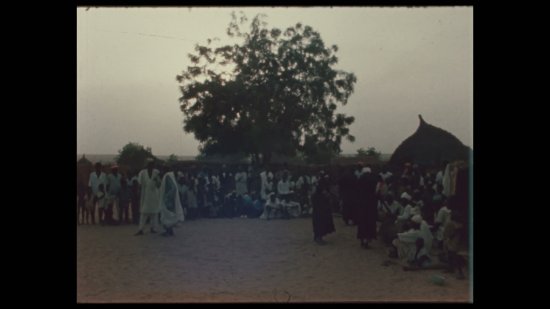
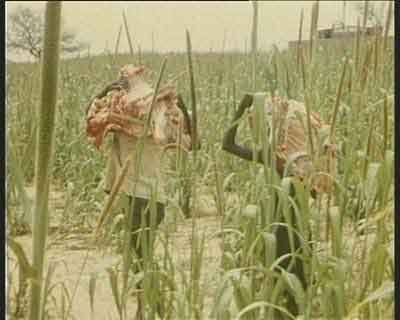
Twenty-one Sorko fishermen from the islands of Firgoun, Ayorou and Koutougou prepare for a hippopotamus hunt on the Niger river - a big event.
Duration
Production year
Définition
Color
Sound
Version(s)
Original material
The use of media visible on the CNRS Images Platform can be granted on request. Any reproduction or representation is forbidden without prior authorization from CNRS Images (except for resources under Creative Commons license).
No modification of an image may be made without the prior consent of CNRS Images.
No use of an image for advertising purposes or distribution to a third party may be made without the prior agreement of CNRS Images.
For more information, please consult our general conditions
Transcription
Opening credits :
00:00:08: This film was made during the 1950-51 research mission of the Institut français d'Afrique noire to the Niger River
Battle on the Great River
A film by Jean Rouch, assisted by Roger Rosfelder
00:00:35: with Damouré Zika, Illo Gaoudel, the chief Oumarou, and the Sorko fishermen from Firgoun, Ayorou, Koutougou
00:00:42: Songs
“Kombine katibaba”
“Sambalaga” (Aissata Gaoudelize)
“Hunters tune” (Yankori Beibatane)
“Paddlers tune” (Mallam Amisou)
“Lullaby” (Hawa de Niamey)
00:00:56: Original audio recordings made in the field. Acemaphone process
Audio adaptation with the assistance of the Musée de l'Homme
Sound recording : Films Pierre Boyer–Paris
00:01:10: This film tells the story of the big battle that took place on the Niger River from January to June 1951 between 21 Sorko fishermen from Firgoun, Ayorou, and Koutougou, and the hippos of Yassane, Baria, Tamoulès, and Labbezenga.
[nota bene: a few geographical or vernacular names are marked by an asterisk (*), for they haven't been found on maps or in scientific publications.]
00:01:26 (Rouch's commentary):
In January 1951, the 21 finest Sorko fishermen of Niger, masters of the river, gathered in the village of Firgoun to prepare for a banghawi, a war on the hippos.
For fighting beasts that weigh several tons, small fishing canoes are too fragile. They have to build a filibero*, a large canoe whose thick planks can withstand the charges and bites.
Special trees such as gyègyè, sééhoy, garbey, bisaw, and tokay are felled in the bush and cut into planks. Under the direction of the chief fisherman Oumarou, these are squared off with an adze and then sewn with ropes around the entire tokay trunk, or yo bongo, the “head” of the large canoe, an essential part of it.
Next to the boatyard is the weapons workshop: zogu, a harpoon with a float, is the major weapon of the Sorko. The float is made from a bundle of light stalks, carefully tied around a central piece of wood.
The wooden core is hollowed out to receive the shaft, to which an iron tip is attached. Dané Doubi, blacksmith and fisherman, blacksmith through his father and fisherman through his mother, hammers this iron tip into a sharp blade to pierce the hippo's hide, with long barbs to keep it stuck in place.
This iron blade is attached by a strong splice to a thick rope that connects it to the float. So when a harpoon has struck an animal, the float on the surface indicates the hippo's location.
The shaft is pushed into the float. The iron blade is firmly fixed in place, the rope is taut, and the whole thing is balanced: the zogu harpoon is ready. But a zogu cannot kill a hippo. A killing spear, or yagyi, is required for this task, carefully hafted by Dané Doubi. Eighty zogu harpoons are ready after a month of work. The large canoe is completed and launched. On 19 February, the Sorko fishermen gather at chief Oumarou's compound to ask the river deities for permission to kill the hippos as these belong to Harakoy Dikko, the Water Spirit. To the sound of calabash drums and a violin, the women of Firgoun dance. They are holey bari, the “horses of the spirits,” who, after many hours of dancing, will become possessed by the river deities.
Suddenly, Fatouma begins to tremble. She is seized by a sacred crisis: it is Bagambaizé, a captive genie of the Water Spirit, who has possessed her. The “quiet women” restrain her, undress her, and clothe her in the deity's costume.
00:06:35:
On following evening, Salamata, a woman hidden by a white blanket, is in turn possessed by Harakoy Dikko, the Water Spirit herself.
After blessing a baby future fisherman by blowing on his stomach, the Water Spirit speaks to the fishermen's chief: “Oumarou, I give you three hippos. But be careful, Sorko people, if you do not respect the rules of fishing and the river, watch out for the Old Bearded Hippo.”
And late at night, to ward off this fearsome threat, the fishermen appeal to the hauka—the spirits of power—to the sound of a guitar.
The fishermen Idrissa and Illo Gaoudel are possessed by Zeneder Dakar, the General of Dakar, and Istanbula, the Man of Istanbul. They burn themselves with torches, foam, and scream. In the secret and savage language of the hauka, they assure the fishermen of their full support.
The next day, 20 February, Illo Gaoudel, who has no memory of his nocturnal crisis, joins the Sorko camp on the islet of Santya*. There, the final preparations are underway. In accordance with the rules of fishing, the Sorko fishermen gather around Chief Oumarou to settle their disputes. In this way, when they go to war against the hippos, the Sorko will all have pure hearts.
Then Oumarou “gives courage” to all his men, that is, he gives them magical water to wash their legs and heads. This ensures that no Sorko will retreat before the angry animals. The zogu harpoons are sharpened one last time, and the fishermen load their formidable weapons into small canoes.
Eight small dugouts, Oumarou, Idrissa, Saydou, Mounkaylou, Bouryé, Abdoulaye, Vera, Ali, and Billo, leave the islet of Santya*.
They are soon joined by the large canoe, which is steered by Bondabou. The war on the hippos has begun.
Slowly, the fleet goes upriver, following the western bank.
Then the canoes cross the river. They pass beneath the rock of Yassane as they proceed upstream towards Bosseido*.
In this season of high water, the hippos have taken refuge in the burgu grass, which stretch in large marshy beds along the banks of the Niger. Sounds of their presence emerge from these marshes. The zogu harpoons are soaked in the river so that their ropes become taut.
The large canoe lies in ambush, and the small ones move as quietly as possible through the burgu to try to catch a hippo coming up to the surface to breathe.
“Yo! Yo!” the Sorko suddenly shout. It is the fisherman Bouryé who manages to throw a harpoon right into the head of a hippo, and before it disappears, Billo hits it with a second zogu harpoon. Then Idrissa and Damouré Zika reach it with their harpoons too. The hippo dives and tries to escape, but the floats on the surface reveal the route it is following. The large canoe goes on the attack. The hippo now has seven harpoons in its head. The rope attached to a float is tied to the large canoe. The battle commences. The hippo attacks, but, entangled in the ropes, it struggles in vain against the canoe, which it can neither break nor overturn. Armed with the yagyi, the killing spear, Illa Gaoudel is now stabbing its head trying to reach its brain stem. It is a bloody fight to the death with no end in sight.
Twenty times, Illa thrusts his spear, breaking the shaft.
It is evening. After hours of combat, the Hippo of Bouryé, a two-ton female, sinks like a stone. The Sorko fishermen have won the first battle.
The Hippo of Bouryé has now been almost entirely eaten. The last chunks are being cured in the sun. A new expedition is being prepared, but disputes have broken out among the Sorko over how to share the catch. Fishing rules are not being respected. Throughout March, hippos take refuge in the grass, disappearing with the harpoons whose ropes they have cut. It is only in April that the spells of the bush are broken.
The river has begun to fall by this time of year, and the hippos have left their burgu refuge for the deep pools in the middle of the river.
To escape the Sorko, hippos have moved upstream over the challenging Labbezenga rapids. But the Sorko are not deterred by foaming waters. They cross the rapids themselves and, with the help of some villagers, also get the large canoe over.
It is 27 April, and the Sorko gathered at Tombo Baro are preparing to attack the hippos of Baria. To make less noise, they line the bows of their canoes with straw bundles to suppress the sound of lapping water.
The harpoons are ready, the Sorko go on the offensive again.
The hippos see them coming and dive.
“Yo!” the cry of victory rings out. Issoufi's harpoon has struck a hippo, which now flees downstream, followed by the canoes. It dives and takes refuge in the grass. But the large canoe goes on the attack.
The final combat takes place on the beach. It is a young three-year-old hippo which the fishermen pull onto land so they can slaughter it more easily.
But the death of Issoufi's young hippo does not bring the fight to an end. Its tender meat will give the fishermen strength to carry on the battle.
Having become aware of the death of Issoufi's hippo, the herd has moved even further up the river to Tamoulès.
On 28 April, the tireless fishermen catch up with the herd at Tibo. Preparations for battle are made.
An enormous male, the “Bearded One” of Tamoulès, protects his herd. However, the fishermen approach, and Sorko Idrissa, in the midst of the river, manages to harpoon him. But the furious hippo charges at the fishermen, smashing Abdou's canoe and throwing him into the water with Idrissa and Nouhou. Only seven canoes remain. Even so, Chief Oumarou decides to attack with the large canoe.
He puts on his magic bonnet and prepares the courage charms.
The large canoe is loaded with all the available harpoons and at the end of the afternoon attacks the old male of Tamoulès.
But it is the hippo who attacks first and, in a furious charge, breaks the bow of the large canoe, which sinks and has to be abandoned by the crew.
Chief Oumarou tries to re-instill some confidence in the discouraged fishermen. After sending a small canoe to follow the wounded hippo, he has the large canoe hauled ashore for repairs.
00:22:00:
The next day, 29 April, all the available men from the village of Koutougou came to Tamoulès to help the Sorko fishermen repair the large canoe.
One of the front planks has been split, and seams have been torn. New ones have been made, and the holes carefully filled.
That same evening, the large canoe, now solidly repaired, is launched back into the water. The great battle can resume.
On 30 April, the Sorko row upstream in pursuit of the escaped Old Bearded Hippo. They pass Sorkawa fishermen sailing by. On 1 May, the wounded hippo is spotted at Tenfakoré*. His water-filled harpoon floats are barely floating.
“Yo!” It is Douma Yaya who casts his harpoon. Illo Gaoudel and Zibo throw two more harpoons. But it is not a hippo who is wounded but rather a Niger “seal”, a manatee.
The manatee is hauled ashore and overturned, it crosses its flippers over its breast before the fatal spear blow is administered.
Yet in the middle of the river, the floats of the hippo injured by Idrissa at Tamoulès are still visible. In the evening, the Sorko wait in vain for the animal to surface so they can harpoon him again.
The Sorko have tracked the wounded hippo throughout the night, and at dawn on 2 May, he is spotted in the burgu grass and attacked from the large canoe.
Twenty Fifteen new harpoons are thrown at the hippo, but he manages to dive into the grass. He succeeds in breaking the ropes tying him to the large canoe and escapes once again.
Alarmed by the noise of the battle, all the hippos have now fled. Except a juvenile, only a few days old, who was unable to keep up with the herd. Fisherman Tyakeo has managed to catch him. He is named Hari Kamba and entrusted to the care of Damouré Zika, who quickly becomes his friend.
Let us leave Damouré Zika and Hari Kamba playing together. On 3 May, the fishermen set off in pursuit of the old male of Tamoulès, who went back down the Labbezenga rapids.
They catch up with the hippo at the Tenfakoré* rapids, which he tries in vain to cross. Seeing the large canoe, he escapes into the burgu grass. The large canoe follows, approaching him. The final combat begins. Harpoons rain down on the hippo every time he surfaces to breathe.
Despite all his injuries, the hippo is still very full of life. He attacks the large canoe, breaking the killing spear, smashing the planks, and splitting the ropes that bind him to it, before fleeing into the grass.
The Sorko fishermen no longer have a large canoe. They no longer have any spears, they no longer have any harpoons, and, above all, they no longer have any courage. In the evening mist, the Great Bearded Hippo of Tamoulès slowly disappears, dragging behind him more than fifty harpoons with their ropes entangled in the river grass.
On 7 May, fog has fallen on the river. The Hippo of Tamoulès is nowhere to be found.
But on the muddy riverbank of Yassane, Damouré Zika and Illo Gaoudel discover footprints. The Hippo of Tamoulès has disappeared into the northern marshes.
It is “the shame of the bush,” “the shame of the hunt”. Chief Oumarou became ill during the night and had to be taken back to the village of Firgoun. At the fishermen's camp, the sorrow of the defeat reigns. The broken harpoons are all that remains of the battle. The fishermen have turned their clothing inside out. These are the boubous of shame, for the Sorko fishermen know how to accept their defeat with courage.
So, with great sadness, the fleet of the defeated fishermen returns to the village. Their hearts are as dark as the desolate grey waters of the Niger under the mist. The Sorko have lost the battle on the Great River.
The End (00:32:56).